African Warblers
The African warblers, belonging to the family Macrosphenidae, are a distinct group of songbirds found across sub-Saharan Africa. Once categorized within the broader Old World warbler family (Sylviidae) or the babbler family (Timaliidae), modern molecular studies have redefined their place in the avian tree. Researchers discovered that these birds are actually a basal offshoot—an early evolutionary branch—of the entire superfamily Sylvioidea, which includes tits, swallows, and larks.
Key Facts
- Family: Macrosphenidae, containing 18 species across 6 genera.
- Distribution: Endemic to sub-Saharan Africa.
- Diet: Primarily insectivorous.
- Conservation: Most are Least Concern, but Pulitzer's longbill is Endangered.
- Behavior: Mostly non-migratory and generally monogamous.
Taxonomy and Classification
The family name was first introduced as a subfamily (Macrospheninae) by German ornithologist Hans Wolters in 1983, though it was not formally defined as a full family until 2012. This reclassification was driven by genetic research, specifically a 2012 study by Silke Fregin and collaborators, which clarified the phylogenetic relationships within the Sylvioidea superfamily.
| Genus | Common Name Group | Example Species | Primary Habitat |
|---|---|---|---|
| Sylvietta | Crombecs | Long-billed crombec | Wooded savanna, arid scrubland |
| Macrosphenus | Longbills | Yellow longbill | Rainforest, forest edges |
| Sphenoeacus | Grassbirds | Cape grassbird | Grassland |
| Achaetops | Rockrunners | Rockrunner | Rocky arid scree, grassland |
| Melocichla | Grass warblers | Moustached grass warbler | Grassland |
| Cryptillas | Warblers | Victorin's warbler | Grassland |
Distribution and Habitat
African warblers are highly adapted to the diverse landscapes of sub-Saharan Africa. Their habitats vary significantly by genus: longbills prefer primary rainforests and open woodlands, while crombecs are found in wooded savannas and arid bushlands. The rockrunner occupies rocky scree and grasslands, and the Cape grassbird and moustached grass warbler are primarily grassland dwellers.
Most species are non-migratory. However, the northern crombec and moustached grass warbler exhibit localized movements in West Africa, which are typically linked to the timing of the rainy season.
Physical Characteristics
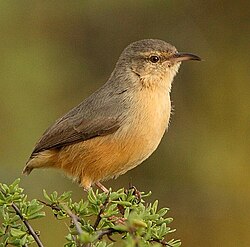
There is a wide range of physical diversity within the family. The smallest members are the crombecs, measuring roughly 8 cm (3.1 in) in length and weighing as little as 6.5 g (0.23 oz). In contrast, the Cape grassbird is significantly larger, reaching lengths of 19–23 cm (7.5–9.1 in), and the moustached grass warbler weighs between 29–40 g (1.0–1.4 oz).
Morphological differences are also evident in their tails. The crombecs possess very short tails that barely extend beyond their folded wings and tail coverts, whereas Victorin's warbler and the two grass warbler species feature long, graduated tails.
Behavior and Ecology
As insectivores, African warblers prey on a variety of insects. Their foraging habits depend on their environment: longbills and crombecs feed in bushes and the forest canopy, while other species are more terrestrial. To avoid competition, some species utilize niche partitioning—a process where species divide resources to coexist. For example, where the red-faced crombec and long-billed crombec overlap, one feeds in the canopy while the other feeds lower in the vegetation.
Breeding is typically seasonal, coinciding with the transition from the dry season to the rainy season. These birds are generally territorial and monogamous. Nesting styles vary by genus: crombecs build deep, pocket-shaped nests suspended from branches, while the Cape grassbird, moustached grass warbler, and Victorin's warbler weave cup-shaped nests from grass.
Conservation Status
While most species are listed as Least Concern by the IUCN, some face significant threats. Pulitzer's longbill is classified as Endangered; endemic to the escarpment forests of western Angola, its population is estimated at fewer than one thousand individuals and continues to decline due to slash-and-burn agriculture and forest clearance.
The status of Chapin's crombec remains uncertain. Due to regional conflict preventing field surveys, it is unknown if the bird still exists or if it has become extinct.
Frequently Asked Questions
Are African warblers related to Old World warblers?
While they were previously classified in the Sylviidae family, molecular studies have shown they are actually a basal offshoot of the larger Sylvioidea clade, making them a distinct evolutionary lineage.
What is the difference between a crombec and a longbill?
Crombecs are generally smaller with very short tails and build pocket-shaped nests, whereas longbills are typically found in rainforests and forest edges.
Do African warblers migrate?
The family is overwhelmingly non-migratory, though the northern crombec and moustached grass warbler make some localized movements in West Africa based on the rainy season.
Which African warbler is most at risk?
Pulitzer's longbill is the most critically threatened, listed as Endangered due to habitat loss in western Angola. Chapin's crombec is also of concern as it may be extinct.