Admiral Lord West of Spithead: A Legacy of Naval Command and National Security
Admiral The Right Honourable Lord West of Spithead (born Alan William John West) is a distinguished retired admiral of the Royal Navy whose career spans the heights of military command and the complexities of British government. From the front lines of the Falklands War to the corridors of power in the Home Office, Lord West has played a pivotal role in shaping the United Kingdom's maritime strategy and national security framework.
Key Facts
- Highest Naval Rank: Admiral, serving as First Sea Lord and Chief of the Naval Staff (2002–2006).
- Political Role: Parliamentary Under-Secretary of State for Security and Counter-Terrorism (2007–2010).
- Military Honors: Knight Grand Cross of the Order of the Bath (GCB) and the Distinguished Service Cross (DSC).
- Academic Leadership: Served as the first Chancellor of Solent University from 2006 to 2018.
- Peerage: Created a life peer as Baron West of Spithead on July 9, 2007.
Early Naval Career and the Falklands War
Born in London in 1948, Alan West began his naval journey in 1965 at the Britannia Royal Naval College. His early years were marked by global deployments, including service on HMS Albion during the Nigerian Civil War and circumnavigating the globe aboard HMS Whitby during the Beira Patrol.
By 1980, West had risen to the rank of commander and took command of the frigate HMS Ardent. His leadership was most severely tested during the 1982 Falklands War. During the operation to retake the islands, HMS Ardent was sunk in Falkland Sound on May 21. Lord West was the last person to leave the sinking vessel, an act of bravery and leadership for which he was awarded the Distinguished Service Cross.
Rise to Senior Command
Following his recovery and promotion to captain in 1985, West's career trajectory continued upward despite a brief setback in 1986 involving a security breach where sensitive documents were accidentally lost. He rebounded to lead the Dartmouth training squadron and head naval intelligence, where he was tasked with rewriting the NATO intelligence manual following the collapse of the Soviet Union.
Throughout the 1990s, he held several critical roles, including Naval Secretary and Commander of the United Kingdom Task Group. In 1997, as Vice Admiral and Chief of Defence Intelligence, he provided vital intelligence for operations in Sierra Leone, East Timor, Kosovo, and Iraq (Operation Desert Fox).
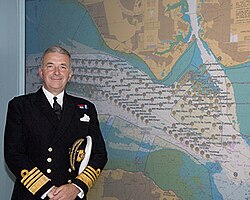
First Sea Lord and Chief of the Naval Staff
In September 2002, West reached the pinnacle of the Royal Navy as First Sea Lord. In this capacity, he was responsible for the fighting effectiveness and morale of the entire Naval Service, including the Royal Marines and Royal Fleet Auxiliary. He oversaw the naval contributions to the invasion of Iraq and implemented the "Delivering Security in a Changing World" white paper, which shifted the Navy's focus from the total number of hulls to the delivery of specific military effects.
One of his most visible achievements was the organization of Trafalgar 200 in 2004, a massive international fleet review celebrating the bicentenary of the Battle of Trafalgar.
Transition to Politics and Public Service
After retiring from active naval service in 2006, Lord West transitioned into academia and politics. He served as the Chancellor of Southampton Solent University for twelve years, fostering the development of future maritime officers.
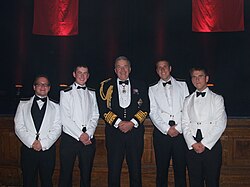
In June 2007, Prime Minister Gordon Brown appointed him as Parliamentary Under-Secretary of State at the Home Office. In this role, he was the primary architect of the UK's first-ever National Security Strategy and Cyber Security strategy. He also formulated policies regarding chemical, biological, radiological, and nuclear security.
Later Life and Public Commentary
As a member of the House of Lords, Lord West has remained a vocal commentator on defense and geopolitics. He has criticized insufficient defense spending and described the military challenges following Brexit as a "perfect storm." More recently, he has provided professional expertise on historical events, including the sinking of the Titanic for the BBC docudrama Titanic Sinks Tonight in 2025.
| Period | Role/Event | Key Contribution/Outcome |
|---|---|---|
| 1982 | Commander, HMS Ardent | Awarded DSC for leadership during the Falklands War |
| 1997–2000 | Chief of Defence Intelligence | Intelligence lead for Kosovo and Sierra Leone |
| 2002–2006 | First Sea Lord | Led Naval Service during the Iraq invasion; organized Trafalgar 200 |
| 2006–2018 | Chancellor, Solent University | Academic leadership and institutional growth |
| 2007–2010 | Home Office Minister | Authored the first UK National Security Strategy |
Frequently Asked Questions
What was Lord West's role during the Falklands War?
He was the commander of the frigate HMS Ardent. He was the last person to leave the ship after it was sunk on May 21, 1982, and received the Distinguished Service Cross for his leadership.
What is the significance of the First Sea Lord position?
The First Sea Lord is the professional head of the Royal Navy and the Chief of the Naval Staff, responsible for the overall effectiveness, morale, and strategic direction of the Naval Service.
What political contributions did Lord West make?
As a minister in the Home Office under Gordon Brown, he created the United Kingdom's first National Security Strategy and its first Cyber Security strategy.
What was the "Trafalgar 200" event?
It was a major celebration of the 200th anniversary of the Battle of Trafalgar, featuring an international fleet review in the Solent, which Lord West was instrumental in persuading the government to hold on a large scale.
Which academic institution did he lead?
He served as the first Chancellor of Southampton Solent University (now Solent University) from June 2006 until the summer of 2018.