Activism Methods: Strategies for Social and Political Change
Activism is the intentional effort to bring about social, political, or environmental change. Whether driven by a lifelong vocation or a spontaneous response to injustice, activists employ a diverse array of tactics—the specific methods used to achieve their goals. The choice of tactic is critical, as it shapes public perception and determines the likelihood of success. Research indicates that nonviolent tactics are generally more than twice as effective as violent ones in achieving stated goals and are more likely to garner public sympathy.
Key Facts
- Nonviolent tactics are significantly more effective and better perceived by the public than violent methods.
- The repertoire of contention refers to the set of proven tactics (like boycotts and marches) available to activists in a specific time and place.
- Internet activism allows citizen-activists to bypass state-controlled media and organize decentralized, leaderless networks.
- Economic activism leverages financial power through methods like ethical consumerism, divestment, and shareholder pressure.
- Artivism uses visual arts and design to spark utopian thinking and increase collective action.
The Repertoire of Contention and Tactical Innovation
Sociologist Charles Tilly introduced the concept of the repertoire of contention. This describes the full range of tactics available to activists at any given time. This repertoire includes historically successful methods such as petitions, sit-ins, marches, and boycotts. When activists encounter police oppression or resistance from countermovements, they often innovate. These new tactics—such as the "activist road trip" proposed by Douglas Schuler—spread through a social process called diffusion, eventually becoming part of the standard repertoire.
While many associate activism with professional organizers, it is practiced by people across all life stages and professions. For example, Helena Alviar Garcia has integrated activism with legal scholarship, demonstrating how academia can serve as a platform for social change.
Political Activism
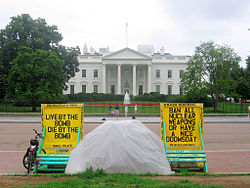
Political activism focuses on influencing government policy, laws, and institutional practices. This can take many forms, from traditional voting and lobbying to acting as public watchdogs and whistleblowers to ensure government transparency.
Motivations and Demographics
Political activism is not tied to a single ideology or age group. While often associated with college students—where both left-wing and conservative movements have seen significant influence—it occurs throughout a person's entire life. In the British Conservative party, research identifies three primary motivations for activism: ambitions for elective office (incentives), a desire to achieve specific policy goals, and strong partisanship (expressive concerns).
Wealth and Judicial Activism
Financial power also plays a role; wealthy individuals may exercise activism through massive financial support for causes. Studies suggest that "old money" tends to be more uniformly conservative than "new money," and while wealthy activism has historically increased inequality, it is sometimes now used to decrease it. Additionally, judicial activism occurs when judges use their positions to promote their own conceptions of the social good, though this remains a controversial political issue.
Internet and Digital Activism
The global impact of Internet activism (or cyber-activism) became prominent during the Arab Spring in 2010. By using social networking and smartphone video, activists in the Middle East and North Africa bypassed state-controlled media to reach an international audience. This paved the way for subsequent movements, such as Spain's 15-M Movement (2011) and Turkey's Occupy Gezi (2013).
Modern digital activism has created a "digital repertoire of contention." This includes hacktivism and the rise of franchise activism, where decentralized, leaderless networks self-organize. However, tactics vary by ideology: left-wing activists often focus on hashtag activism and offline protests, while right-wing activists may strategically use alternative platforms, legacy media manipulation, and disinformation.
A specific branch of this movement is digital rights, led by organizations like the Electronic Frontier Foundation, which work to protect human rights in relation to information and communications technologies (ICTs).
Economic Activism
Economic activism uses the financial power of consumers, businesses, and governments to force policy changes. This is often achieved through ethical consumerism (supporting "good" companies) or boycotts and divestment (penalizing "bad" behavior).
| Type | Primary Method | Goal |
|---|---|---|
| Consumer Activism | Boycotts, veganism, simple living | Consumer protection and ethical production |
| Brand Activism | Corporate leadership in social change | Solving global problems to build sustainable customer relationships |
| Shareholder Activism | Using equity stakes to pressure management | Financial gains or non-financial goals (e.g., environmental policies) |
| Tax Resistance | Refusal to pay taxes | Opposition to specific government policies or taxation itself |
Art, Science, and Specialized Activism
Artivism and Design
Art activism, or "artivism," uses visual arts to provide social commentary and activate utopian thinking—the imagination of an ideal society—which helps increase collective action. Related fields include design activism, which questions mass production and consumerism, and craftivism, where "craftivists" use creative crafts to send clear political messages. In the fashion industry, fashion activism (a term coined by Celine Semaan) uses a participatory approach to ignite awareness and support change.
Science Activism
Science activism involves advocating for research funding, improving science communication, or responding to the politicization of scientific fields. A prominent example was the global March for Science in 2017 and 2018. While effective for visibility, some scholars note that scholarly activism on political topics can potentially reduce the perceived separation between science and advocacy, affecting scientific credibility.
Frequently Asked Questions
What is the difference between a tactic and a repertoire of contention?
A tactic is a specific method used to achieve a goal (like a boycott), while the repertoire of contention is the entire collection of proven tactics available to activists in a particular time and place.
Why are nonviolent tactics generally preferred?
Nonviolent tactics tend to garner more public sympathy and have been found to be more than twice as effective as violent tactics in achieving their stated goals.
What is brand activism?
Brand activism occurs when a business takes a leading role in social change, attempting to solve global problems that its employees and future customers care about to build long-term relationships.
How does internet activism differ from traditional activism?
Internet activism allows for the rapid diffusion of information, the ability to bypass state-controlled media, and the creation of decentralized, leaderless networks known as franchise activism.
What is the goal of shareholder activism?
Shareholder activists use their ownership stake in a company to pressure management for either financial improvements (like cost-cutting) or non-financial changes (like adopting environmentally friendly policies).