Accommodation of the Eye: Mechanisms of Visual Focus
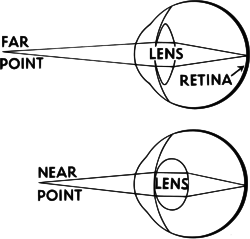
Accommodation is the biological process by which the vertebrate eye adjusts its optical power to maintain a clear image of an object as its distance changes. This mechanism allows the eye to shift focus between the far point—the maximum distance at which an object remains clear—and the near point—the minimum distance required for a clear image. While accommodation often functions as an automatic reflex (part of the accommodation-convergence reflex), it can also be controlled consciously.
The primary method animals use to achieve this focus is by altering the shape or position of the lens to change how light is refracted before it hits the retina.
Key Facts
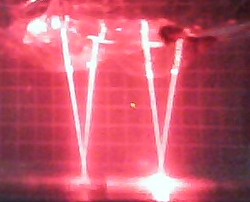
- Function: Adjusts optical power to maintain focus across varying distances.
- Human Range: A young human eye can focus from infinity down to approximately 6.5 cm.
- Power Shift: This transition involves a change of roughly 15 dioptres (the reciprocal of focal length in metres).
- Speed: In bright light, the eye can adjust focus in as little as 224 ± 30 milliseconds.
- Ageing: Accommodative amplitude declines with age, typically dropping below 2 dioptres by age 45–50.
Mechanisms of Focus in Land Animals
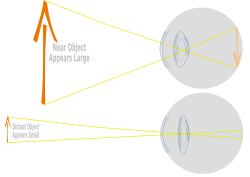
In land-based vertebrates, focusing is primarily achieved by changing the shape of the lens. Two main theories explain how this occurs: external forces and internal forces.
External Forces: The Helmholtz Model
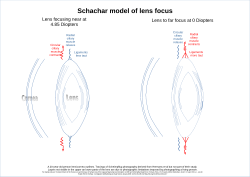
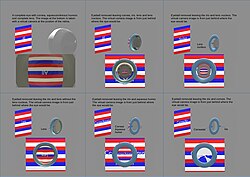
Proposed by Thomas Young in 1800 and later refined by Hermann von Helmholtz and Thomas Henry Huxley, this model focuses on the ciliary muscle. Under normal conditions, the lens is held under tension by suspensory ligaments and the capsule, pulled tight by the pressure of the eyeball. To focus on a near object, the ciliary muscle contracts, which relieves tension on the suspensory ligaments. This allows the elastic lens to become more spherical, increasing its refractive power.
To shift focus to a distant object, the ciliary muscles relax, allowing the ciliary body to spring back. This increases the pull on the lens, making it thinner and less curved, thereby increasing the focal distance.
Internal Forces: Intracapsular Accommodation
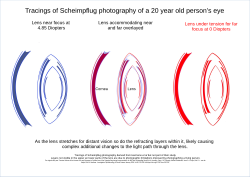
An alternative theory, known as intracapsular accommodation, suggests that the lens is not a passive object but may actively change its own properties. While Thomas Young initially hypothesized that the lens might be a muscle, modern research focuses on water dynamics. The lens contains aquaporins (proteins that allow water flow) and connexins (proteins allowing electrical coupling between cells).
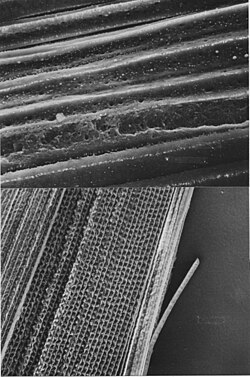
Evidence from MRI and Scheimpflug photography suggests the lens has a layering system with a varying refractive index—ranging from approximately 1.406 in the center to 1.386 in less dense layers. This gradient enhances optical power. Some evidence, such as wrinkled fibers observed in relaxed sheep lenses, suggests that lens fibers may shorten during near-focus accommodation.
Human Visual Accommodation and Ageing
The ability to accommodate is most potent in youth but declines predictably over time. This decline is graphically represented by Duane's classical curves, which show the mean and standard deviations of accommodative amplitude across different ages.
By the fifth decade of life, many individuals experience presbyopia, where the near point moves beyond a comfortable reading distance. The impact of presbyopia depends on the individual's existing vision:
- Emmetropic (normal distance vision): Require reading glasses.
- Myopic (nearsighted): May see better up close if they remove their distance correction.
- Hyperopic (farsighted): May require correction for both near and far vision.
By age 70, the amplitude of accommodation typically decreases to about 1 dioptre.
![Duane's classical curves showing the amplitude or width of accommodation as changing with age. Mean (B) and approximate lower (A) and upper (C) standard deviations are shown.[31]](/images/78/2f/782f339011be52afe9453889fe2d52910dcab95b032edfa01162cc6fee1ae7cd.webp)
Comparative Anatomy: Aquatic Animals
Aquatic animals face different optical challenges because water has a refractive index closer to that of the eye than air does. Consequently, they often employ different strategies.
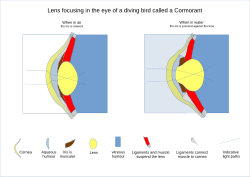
- Diving Birds: The Cormorant can achieve a focusing power of up to 80 dioptres to maintain clarity underwater.
- Bony Fish: These animals possess a more spherical lens than land animals and use a retractor lentis muscle to physically pull the lens backward to adjust focus.
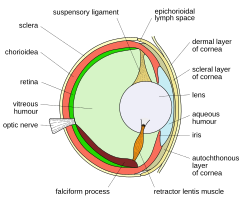
Summary of Accommodation Characteristics
| Subject | Mechanism | Key Characteristic | Typical Power/Range |
|---|---|---|---|
| Young Human | Lens shape change | Ciliary muscle contraction | ~15 dioptres (down to 6.5 cm) |
| Older Human (70y) | Reduced elasticity | Presbyopia | ~1 dioptre |
| Cormorant | High refractive power | Underwater adaptation | Up to 80 dioptres |
| Bony Fish | Lens movement | Retractor lentis muscle | Spherical lens |
Frequently Asked Questions
What is the difference between the far point and the near point?
The far point is the maximum distance from the eye at which an object can be seen clearly, while the near point is the minimum distance required for a clear image.
How does the ciliary muscle affect focus?
According to the Helmholtz model, when the ciliary muscle contracts, it reduces tension on the suspensory ligaments, allowing the lens to become more spherical and increase its refractive power for near vision.
What is presbyopia?
Presbyopia is the age-related loss of the eye's ability to accommodate, typically occurring by the fifth decade of life, which makes it difficult to focus on close objects.
How do fish focus differently than humans?
Unlike humans who change the shape of the lens, bony fish have a more spherical lens and use a specialized muscle called the retractor lentis to move the lens backward to adjust focus.
What role does water play in the human lens?
Research suggests that water dynamics, facilitated by proteins like aquaporins, may allow the lens to change its overall refractive index, meaning the lens is not entirely passive during accommodation.