Academic Journals: The Evolution and Function of Scholarly Publishing
In the world of higher education and scientific advancement, academic journals serve as the primary engine for progress. These periodical publications act as permanent, transparent forums where scholarship within specific disciplines is shared, scrutinized, and debated. Unlike professional or trade magazines, which are often written by staff journalists, the content of a scholarly journal is produced by researchers themselves.
To ensure the integrity of the information shared, most journals utilize a process known as peer review. This involves a rigorous scrutiny of research by contemporaries who are competent and established experts in the same field. This mechanism helps maintain high standards of accuracy and relevance across the global scientific community.
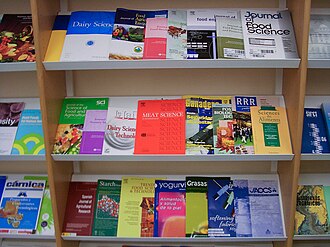
There are different types of peer-reviewed research journals; these specific publications are about food science.
Key Facts
- Academic journals provide a formal platform for the dissemination and scrutiny of research.
- The Philosophical Transactions of the Royal Society (1665) is the world's first scientific journal.
- Peer review is a near-universal requirement for research articles to ensure quality.
- As of 2012, there were an estimated 28,100 active academic journals in publication.
- The growth rate of scholarly publications averaged approximately 3.46% per year between 1800 and 2003.
The History of Scholarly Communication
Before the formalization of journals, scientists communicated through personal letters and organized meetings. The mid-17th century saw the rise of influential scientific organizations, such as the Royal Society (1660) and the French Academy of Sciences (1666). These institutions laid the groundwork for structured scientific communication.
The concept of a journal designed to inform the "Republic of Letters" was first proposed by François Eudes de Mézeray in 1663. While his specific project never launched, humanist scholar Denis de Sallo and printer Jean Cusson successfully established the Journal des sçavans in 1665. This publication aimed to review major European books, publish obituaries of notable figures, and report on scientific and artistic discoveries.
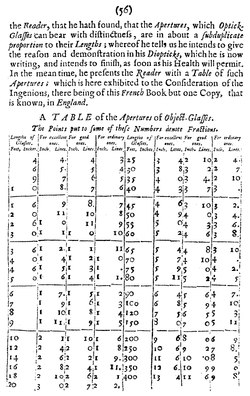
Adrien Auzout's "A TABLE of the Apertures of Object-Glasses" from a 1665 article in Philosophical Transactions, showing a table
Shortly after, the Royal Society launched the Philosophical Transactions of the Royal Society in March 1665, followed by the Mémoires de l'Académie des Sciences in 1666. By the end of the 18th century, nearly 500 such periodicals existed, with Germany, France, and England leading the way in production.
Milestones in Publishing Evolution
The history of publishing is marked by several transformative shifts:
- 1733: Establishment of Medical Essays and Observations, the first fully peer-reviewed journal.
- 1869 & 1880: The founding of the prestigious journals Nature and Science.
- 1990: Postmodern Culture becomes the first online-only journal.
- 1991: The launch of arXiv, a platform for disseminating preprints (research papers shared before formal peer review).
- 2006: The foundation of PLOS One, the first "megajournal."
Anatomy of a Scholarly Article
While formats vary, most research articles follow a standardized structure to help readers navigate complex information. A typical article includes:
- Title: A concise description of the study.
- Author Information: Identifying the researchers responsible for the work.
- Abstract: A single-paragraph summary of the entire article.
- Findings or Results: A summary of what the study actually discovered.
Modern Challenges: Quality and Digital Access
The transition to electronic publishing has significantly increased accessibility. However, the lower entry costs of digital platforms have given rise to predatory journals. These "junk" journals often mimic the names of established publications and solicit articles via email, charging authors fees without providing genuine peer review. Research librarian Jeffrey Beall identified hundreds of such publishers, noting that the actual number may reach into the thousands.
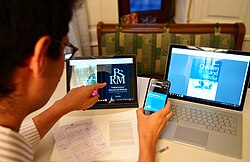
In the 21st century, journals are commonly accessed digitally.
Assessing Journal Quality
To distinguish high-quality research from lower-standard publications, scholars use several assessment techniques, including:
- Stated preference: Based on what researchers say they prefer.
- Revealed preference: Based on actual behavior and choices.
- Publication power approaches: Measuring the impact and influence of the journal.
Summary of Journal Evolution and Metrics
| Era/Milestone | Key Development | Significance |
|---|---|---|
| 1665 | First Scientific Journals | Formalized scientific communication. |
| 1733 | Peer Review Introduction | Increased submission quality and pertinence. |
| 1990s | Digital & Preprint Era | Increased speed and accessibility of research. |
| Modern Day | Predatory Publishing Concerns | highlights the need for rigorous quality checks.
Frequently Asked Questions
What is the difference between an academic journal and a magazine?
Academic journals are written by researchers for an audience of experts and undergo a rigorous peer-review process. Professional or trade magazines are typically written by staff writers for a general professional audience and do not follow the same scrutiny standards.
What is peer review?
Peer review is a quality-control process where experts in a specific field evaluate a research paper before it is published. This ensures the research is accurate, original, and methodologically sound.
What are predatory journals?
Predatory journals are publications that charge authors to publish their work but lack legitimate editorial and peer-review standards. They often use deceptive tactics, such as names similar to well-known journals, to solicit submissions.
What is a preprint?
A preprint is a version of a scholarly paper that is shared publicly (often via platforms like arXiv) before it has undergone formal peer review or publication in a traditional journal.
How can I find reliable academic journals?
Researchers often use specialized databases to find and verify journals, such as Web of Science, Scopus, JSTOR, ScienceDirect, and PubMed.