Abstract Art: The Evolution of Non-Representational Visual Language
Abstract art is a visual language that utilizes shape, form, color, and line to create compositions that exist independently from visual references in the physical world. Often used interchangeably with terms like non-figurative, non-objective, or non-representational art, abstraction represents a departure from the accurate depiction of reality.
This departure exists along a continuum. Partial abstraction occurs when an artist takes liberties with color or form while maintaining a recognizable subject. In contrast, total abstraction bears no trace of any reference to the natural world. For example, geometric abstraction rarely references naturalistic entities, making it almost mutually exclusive with figurative art.
Key Facts
- Definition: Art that does not attempt to represent an accurate depiction of visual reality.
- Continuum: Ranges from partial abstraction (altered reality) to total abstraction (no recognizable reference).
- Catalysts: Developed in response to fundamental changes in technology, science, and philosophy at the end of the 19th century.
- Key Movements: Includes Orphism, Suprematism, Neo-Plasticism, and the Bauhaus philosophy.
- Global Shift: The rise of totalitarianism in Europe during the 1930s led to a massive exodus of abstract artists to New York.
The Shift from Tradition: 19th Century Europe
From the Renaissance to the mid-19th century, Western art was dominated by the logic of perspective and the goal of reproducing an illusion of reality. However, as church patronage declined and private patronage grew, artists gained greater independence. Movements such as Romanticism, Impressionism, and Expressionism began to pave the way for abstraction.
Early signs of this shift appeared in the work of James McNeill Whistler, who prioritized visual sensation over the depiction of objects.
![James McNeill Whistler, Nocturne in Black and Gold: The Falling Rocket (1874),[5][6] Detroit Institute of Arts](/images/9d/df/9ddfc73382ea06538b24c538ab58186ecbef1de3f47505c2ff9ee19b5836d2b1.jpg)
Similarly, Georgiana Houghton utilized abstract shapes in her "spirit" drawings as early as 1871, long before abstraction became a formalized concept.
The Birth of Pure Art in the Early 20th Century
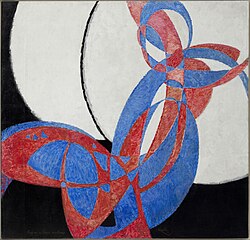
By the early 1900s, artists began searching for a "pure art"—structures created entirely by the artist rather than borrowed from the visual sphere. This led to the emergence of Orphism, a term coined by poet Guillaume Apollinaire to describe the work of artists like Robert Delaunay and František Kupka.
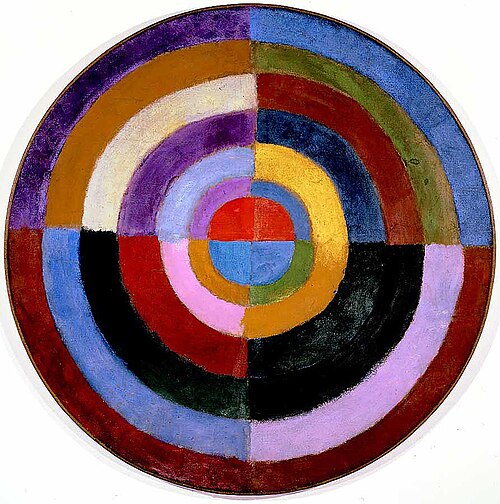
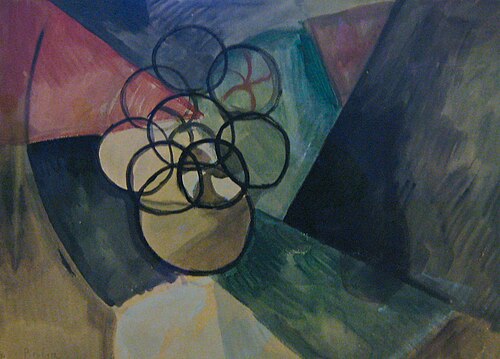
Between 1909 and 1913, a wave of experimental works emerged. Francis Picabia explored mechanical and abstract forms, while Wassily Kandinsky produced pioneering abstract watercolors.
František Kupka contributed significant Orphist works, emphasizing the rhythmic and musical qualities of painting.
The Rise of Suprematism and Neo-Plasticism
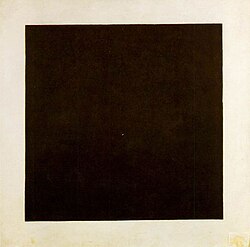
The search for abstraction took different paths across Europe. In Russia, Kazimir Malevich founded Suprematism, culminating in the stark, total abstraction of the Black Square in 1915.
Meanwhile, Piet Mondrian developed Neo-Plasticism, an aesthetic characterized by a strict grid of horizontal and vertical lines and primary colors. Along with Theo van Doesburg and the De Stijl group, Mondrian sought to use this language to reshape the future environment.
Institutional Influence and Political Upheaval
The Bauhaus
Founded in 1919 by Walter Gropius in Weimar, Germany, the Bauhaus school promoted the unity of all visual and plastic arts. Teachers such as Paul Klee and Wassily Kandinsky integrated abstract theory into a curriculum that spanned architecture, weaving, and painting. However, the school was closed by the Nazi party in 1932, and avant-garde works were later branded as "degenerate art" (Entartete Kunst) in 1937.
The Migration to Paris and London
The rise of totalitarianism forced many artists to flee to Paris and London. This concentration of diverse styles led to the formation of groups like Cercle et Carré and Abstraction-Création. Theo van Doesburg further refined the movement through his journal Art Concret, arguing that line, color, and surface are the only concrete realities of art.
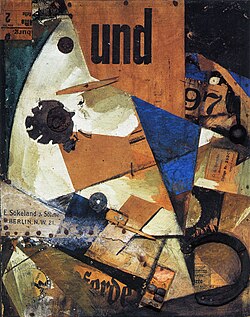
The New York Era and Late 20th Century
By the 1940s, New York became the global center for modern art as exiled Europeans—including Marcel Duchamp and Piet Mondrian—brought their influences to the United States. This environment of freedom allowed local American artists to mature and develop their own abstract styles.
Mondrian's later work, such as Composition No. 10, continued to define the radical approach to the rectangle, while maverick artists like Georgia O'Keeffe pursued highly abstract forms outside of any specific group.
![A 1939–1942 oil on canvas painting by Piet Mondrian titled Composition No. 10. Responding to it, fellow De Stijl artist Theo van Doesburg suggested a link between non-representational works of art and ideals of peace and spirituality.[34]](/images/3c/f3/3cf3302678d963faf3fd428dc9d78005cb1c7829637088e350dc87ffb35d2b57.jpg)
Diversification of Abstraction
The latter half of the 20th century saw abstraction splinter into numerous specialized directions, including:
- Minimalism: Reducing art to its most essential elements.
- Color Field Painting: Large areas of a single color to create emotional resonance.
- Op Art: Using optical illusions to create the impression of movement.
- Hard-edge Painting: Characterized by abrupt transitions between color areas.
Summary of Major Abstract Movements
| Movement | Key Characteristics | Notable Artists |
|---|---|---|
| Orphism | Pure art, new structures, focus on light and color | Robert Delaunay, František Kupka |
| Suprematism | Total abstraction, basic geometric forms | Kazimir Malevich, Liubov Popova |
| Neo-Plasticism | Horizontal/vertical lines, primary colors, grids | Piet Mondrian, Theo van Doesburg |
| Bauhaus | Unity of visual arts, functionalism, theoretical abstraction | Paul Klee, Wassily Kandinsky |
Frequently Asked Questions
What is the difference between non-objective and non-representational art?
While often used interchangeably, these terms generally refer to art that does not represent any specific object from the visible world. Non-objective art specifically emphasizes that the work was not derived from a real-world object, whereas non-representational art simply does not represent one.
How does partial abstraction differ from total abstraction?
Partial abstraction involves altering the colors or forms of a recognizable subject. Total abstraction, such as geometric abstraction, removes all traces of recognizable references to the natural world.
Why did so many abstract artists move to New York in the 1930s and 40s?
The rise of totalitarian regimes in Europe, particularly the Nazi party in Germany, led to the persecution of avant-garde artists. Their work was labeled "degenerate," forcing them to seek political asylum and artistic freedom in the United States.
What was the goal of the De Stijl movement?
The De Stijl group, including Piet Mondrian and Theo van Doesburg, aimed to create a universal aesthetic based on Neo-Plasticism to reshape the environment of the future through simplicity and harmony.
What role did the Bauhaus play in abstract art?
The Bauhaus served as a critical educational hub that unified various artistic disciplines. It integrated the theoretical study of abstraction into practical design and architecture, influencing a generation of artists who later spread these ideas globally.