3 Times Square: The Evolution of a Manhattan Landmark
Standing at the crossroads of New York City's most vibrant district, 3 Times Square represents more than just corporate office space; it is a testament to the complex urban redevelopment of Midtown Manhattan. From early government proposals in the 1980s to its current role as a multi-tenant hub, the building's history reflects the shifting economic and architectural tides of the city.
The Planning and Political Struggle
The origins of 3 Times Square date back to 1981, when the Empire State Development Corporation (ESDC)—a New York state agency—proposed a massive redevelopment of West 42nd Street. The initial vision, crafted by architects Philip Johnson and John Burgee, called for four towers at the intersections of Broadway and Seventh Avenue. The tower slated for the 3 Times Square site was originally planned as a 29-story structure encompassing 705,000 square feet.
However, the project faced significant hurdles. The Durst Organization opposed the redevelopment for 15 years, arguing that government subsidies for other developers would diminish the value of their own holdings. Combined with the inability of partners Prudential Insurance Company of America and Park Tower Realty to secure tenants, the project was postponed in 1992. By this time, Prudential had already spent $300 million on land acquisition through eminent domain—the legal process by which a government takes private property for public use with compensation.
To maintain the area's vibrancy during this delay, the city implemented zoning regulations in the West Midtown special zoning district. These rules encouraged developers to install large, bright signage to ensure Times Square remained illuminated after dark.
The Reuters Proposal and Development
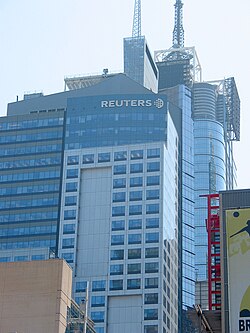
The momentum shifted in 1997 after the successful completion of 4 Times Square. The news agency Reuters sought a centralized New York headquarters to consolidate 1,800 employees from 13 different locations. Partnering with Rudin Management, Reuters planned a 32-story building totaling 855,000 square feet.
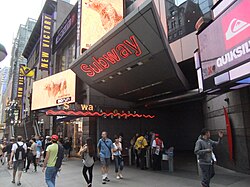
The development was not without controversy. To incentivize the $400 million project, Mayor Rudy Giuliani's administration provided tax exemptions totaling $26 million, sparking criticism that the area had become a hub for "corporate welfare." Additionally, a dispute arose with the Metropolitan Transportation Authority (MTA) regarding a new subway entrance. Rudin Management paid $1.3 million to avoid installing required escalators, a move that later drew scrutiny from an MTA inspector who claimed the cost should have been significantly higher.
Construction Challenges and Completion
Construction began in earnest with a groundbreaking on January 11, 1999. The process was technically demanding; the 32,000-square-foot site had to be excavated 32 feet deep while protecting nearby historic structures and active subway tunnels. Tishman Construction and Urban Foundation managed the substructure, reinforcing the foundations of adjacent buildings with concrete.
Despite a citywide shortage of skilled ironworkers, the steel superstructure rose quickly, topping out on December 10, 1999. The building's completion coincided with a surge in commercial rents in Times Square, a neighborhood that had previously been avoided by many high-end corporate tenants.
Corporate Tenancy and Usage
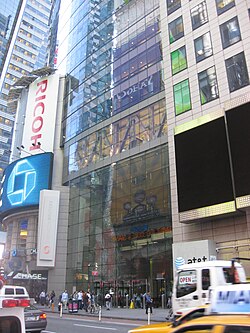
The building officially opened on June 4, 2001. Its primary tenant, Reuters, occupied 625,000 square feet, while other major firms like Bain & Company and the Bank of Montreal (BMO) filled the remaining office space. The building also became a site for high-profile retail, including Chase Bank and Skechers.
Over the years, the building adapted to changing corporate landscapes. Following the merger of Reuters and Thomson Corporation in 2007, the entity became Thomson Reuters. The building also engaged in innovative advertising partnerships, such as a 2006 agreement with Nasdaq to synchronize digital advertisements across 3 Times Square and the Nasdaq MarketSite at 4 Times Square.
Modern Renovations and New Era
In April 2021, Rudin Management launched a $25 million renovation to modernize the property. This project, designed by FXCollaborative, included a redesigned lobby and a new amenity area on the 16th floor. This refresh attracted new diverse tenants, most notably the Touro College and University System, which leased over 243,000 square feet to consolidate seven of its schools into one location.
Key Facts
- Total Height: 32 stories.
- Primary Developer: Rudin Management in partnership with Reuters.
- Major Tenants: Thomson Reuters, Touro College, Bank of Montreal, and JAMS.
- Construction Cost: Approximately $400 million for the headquarters.
- Valuation: Estimated at $700 million as of October 2020.
- Key Feature: Integrated subway entrance to the Times Square–42nd Street station.
| Phase | Key Entity | Significant Detail |
|---|---|---|
| Early Planning (1981) | ESDC | Proposed four-tower redevelopment plan. |
| Development (1997-2001) | Rudin & Reuters | Construction of 32-story HQ with tax incentives. |
| Corporate Shift (2007) | Thomson Reuters | Merger led to rebranding and office relocation. |
| Modernization (2021) | Rudin Management | $25 million renovation and lobby redesign. |
Frequently Asked Questions
Who originally proposed the redevelopment of the 3 Times Square site?
The Empire State Development Corporation (ESDC), a New York state agency, first proposed the redevelopment of the area around West 42nd Street in 1981.
Why was the construction of the building controversial?
The project faced criticism due to $26 million in tax exemptions granted by Mayor Rudy Giuliani's administration and a $1.3 million payment made to the MTA to avoid installing escalators at the subway entrance.
How did the building's use change after the Reuters merger?
After Reuters merged with the Thomson Corporation in 2007 to form Thomson Reuters, the building continued to serve as a corporate hub, eventually subleasing space to companies like Kind Snacks and relocating various Thomson offices.
What major changes were made during the 2021 renovation?
Rudin Management invested $25 million to redesign the lobby and add a 16th-story amenity area, helping to attract new tenants like the Touro College and University System.
What is the relationship between 3 Times Square and 4 Times Square?
While separate buildings, they collaborated on advertising in 2006, allowing companies to run synchronized or split advertisements across both the northeast corner of 3 Times Square and the Nasdaq MarketSite at 4 Times Square.