2018 South Korean Local Elections: A Landslide Victory for the Democratic Party
On 13 June 2018, South Korea held its 7th local elections, a pivotal moment in the nation's political landscape. The elections, which coincided with by-elections for vacant seats in the National Assembly, resulted in a significant landslide victory for the ruling Democratic Party of Korea (DPK). This political shift occurred following high-profile diplomatic milestones, including the third inter-Korean summit in April and the first North Korea-United States summit in Singapore in early June.
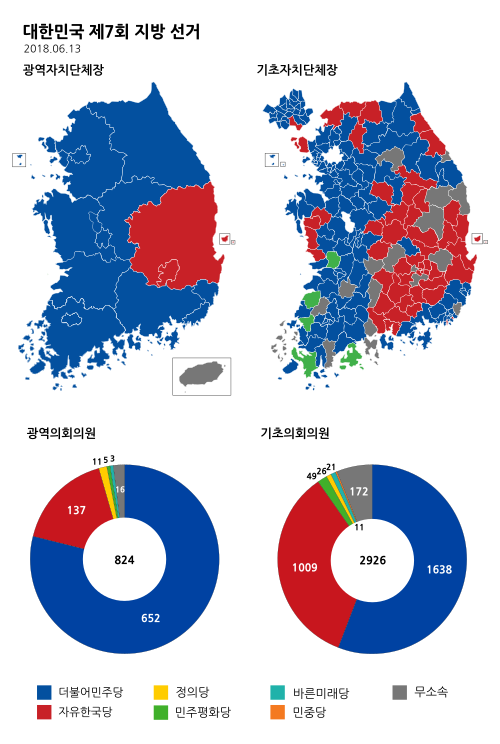
The elections involved the selection of 17 regional heads, 824 regional councilors, 226 municipal mayors, and 2,926 municipal councilors. With a voter turnout of 60.2%, the results reflected a strong mandate for the Democratic Party across various levels of government.
Key Facts
- Dominant Party: The Democratic Party of Korea secured a massive majority in both regional and municipal seats.
- Voter Turnout: 60.2% of the 42,907,715 registered voters participated.
- Regional Leadership: The DPK won 14 out of 17 regional heads.
- Municipal Leadership: The DPK won 151 out of 226 municipal mayoral positions.
- Major Shift: The DPK saw significant gains in municipal mayors (+71) and municipal councilors (+481) compared to the previous election.
Regional Head and Council Results
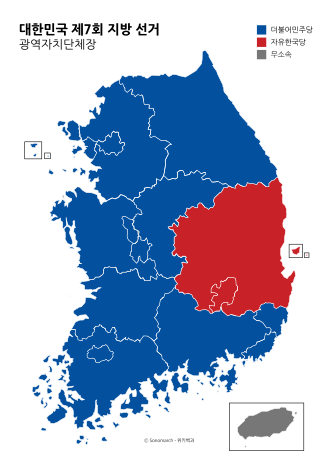
The regional elections saw the Democratic Party capture the vast majority of leadership roles. Out of the 17 regional heads contested, the DPK secured 14, representing a gain of 5 heads compared to the previous election. In contrast, the Liberty Korea Party (LKP), the primary opposition, saw its regional head count drop to 2.
Regional Head Election Breakdown
The Democratic Party dominated the vote share for regional heads, securing 56.01% of the total votes. The Liberty Korea Party followed with 31.12%.
| Party | Votes | Percentage | Seats Won | Change |
|---|---|---|---|---|
| Democratic Party | 14,191,438 | 56.01% | 14 | +5 |
| Liberty Korea Party | 7,884,768 | 31.12% | 2 | -6 |
| Independents | 204,975 | 0.81% | 1 | +1 |
Regional Councilors
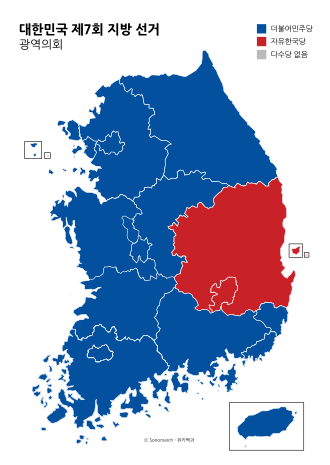
The regional council elections, which involve representatives at the provincial or metropolitan level, also favored the DPK. The party won 652 seats, a substantial increase of 303 seats from the previous election. The Liberty Korea Party saw a significant decrease, losing 279 seats.
Municipal Leadership and Local Governance
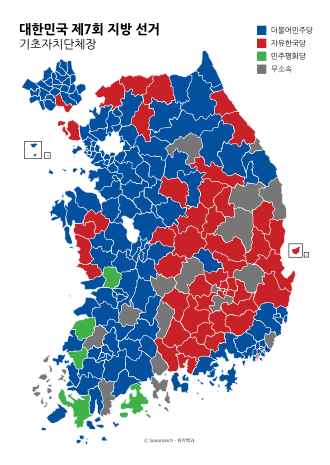
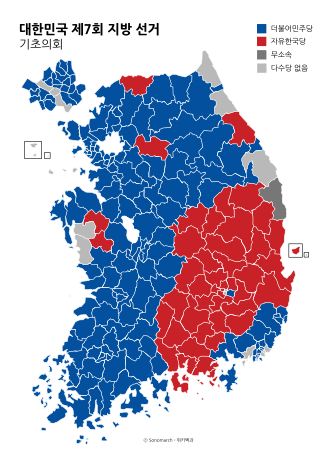
At the municipal level—covering cities, counties, and autonomous districts—the Democratic Party's momentum continued. The party won 151 mayoral positions, marking a gain of 71 seats from the last election cycle. The Liberty Korea Party's influence at this level diminished, dropping to 53 mayors.
Municipal Mayoral Summary
The distribution of municipal mayors highlights the widespread support for the DPK across the country, including major metropolitan areas like Seoul, Busan, and Incheon.
| Party | Votes | Percentage | Seats Won | Change |
|---|---|---|---|---|
| Democratic Party | 13,453,673 | 54.14% | 151 | +71 |
| Liberty Korea Party | 7,566,555 | 30.45% | 53 | -64 |
| Independents | 1,557,021 | 6.27% | 17 | -12 |
Municipal Councilors
The municipal councilors, who serve at the local district or county level, saw the largest numerical shifts. The Democratic Party secured 1,638 seats, an increase of 481. The Liberty Korea Party saw its count fall to 1,009, a decrease of 404 seats.
Frequently Asked Questions
Which party won the most seats in the 2018 local elections?
The Democratic Party of Korea won the most seats across all categories, including regional heads, municipal mayors, and both regional and municipal councilors.
What was the voter turnout for the 2018 elections?
The voter turnout was 60.2%, based on 25,832,076 total votes cast out of 42,907,715 registered voters.
How did the Liberty Korea Party perform?
The Liberty Korea Party saw a significant decline in seats across most levels of government, losing 6 regional heads, 64 municipal mayors, and 279 regional councilors compared to the previous election.
Who won the mayoral election in Seoul?
Park Won-soon of the Democratic Party won the Seoul mayoral election with 2,619,497 votes (52.79%).
What was the significance of the timing of these elections?
The elections took place shortly after major diplomatic developments, specifically the third inter-Korean summit and the first North Korea-United States summit in Singapore.