1956 Olympic Football Tournament: Soviet Union Claims Gold in Melbourne
The association football tournament at the 1956 Summer Olympics, hosted in Australia, stands as a pivotal moment in sporting history. Held from November 24 to December 8, the competition saw the Soviet Union secure its first Olympic title in a tournament heavily influenced by the geopolitical tensions of the Cold War era.
The event was marked by significant absences. Defending champions Hungary withdrew following the Soviet invasion of their country, while other nations including Spain, the Netherlands, Switzerland, and Liechtenstein also ignored the tournament. Further boycotts occurred due to the Suez Crisis, and China abstained to protest the International Olympic Committee's (IOC) recognition of Taiwan.
Key Facts
- Champions: Soviet Union (1st title)
- Host City: Melbourne, Australia
- Total Goals: 53 goals across 12 matches (4.42 per match)
- Total Attendance: 194,333 spectators
- Top Scorers: Neville D'Souza, Todor Veselinović, and Dimitar Milanov (4 goals each)
- Historic Milestone: First tournament where all medalists were communist countries.
Tournament Background and Dynamics
The 1956 tournament featured 11 teams, including three from the Eastern Bloc and four from Asia. Other participants included the United States, Great Britain, the hosts Australia—making their Olympic football debut—and the United Team of Germany (which functioned de facto as West Germany).
A defining characteristic of this era was the disparity between state-funded athletes from Eastern Bloc countries and the amateurs of the West. This financial advantage allowed the Soviet Union and its satellite states to dominate Olympic football from 1952 onwards.
Venues
The competition was hosted in Melbourne across two primary venues:
- Olympic Park Stadium
- Melbourne Cricket Ground (MCG), which boasted a capacity of 104,000.
The Road to the Final
First Round
Due to several withdrawals after the draw—including China, Egypt, Turkey, and Vietnam—only three matches were played in the opening round. The Soviet Union defeated the United Team of Germany 2–1, Great Britain dominated Thailand 9–0, and Australia beat Japan 2–0.
Quarter-finals
The quarter-finals saw Yugoslavia crush the United States 9–1. Bulgaria defeated Great Britain 6–1 in a match noted for an unusual incident where ratings from the HMS Newcastle entered the field to encourage the British team.
The Soviet Union advanced after a 0–0 draw and a subsequent 4–0 victory in a replay against Indonesia. Meanwhile, India defeated Australia 4–2, featuring a historic hat trick by centre forward Neville D'Souza, the first ever by an Asian player in the Olympics. Notably, the Indian team chose to wear boots for this match despite previous debates over whether they should play barefoot.
Semi-finals and Medal Matches
Yugoslavia reached their third consecutive final by defeating India 4–1. The Soviet Union progressed to the gold medal match after a tense 2–1 victory over Bulgaria, scoring twice in the final six minutes of extra time.
In the bronze medal match, Bulgaria secured third place with a 3–0 win over India.
The Gold Medal Match
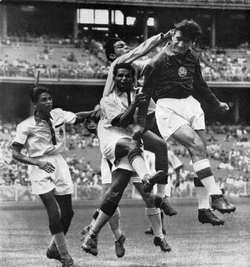
The final took place on December 8 at the Melbourne Cricket Ground before a massive crowd of 86,716. The Soviet Union defeated Yugoslavia 1–0, with Anatoli Ilyin scoring the decisive goal in the 48th minute to secure the gold medal.
Tournament Summary
| Category | Details |
|---|---|
| Champion | Soviet Union |
| Runner-up | Yugoslavia |
| Third Place | Bulgaria |
| Fourth Place | India |
| Total Matches | 12 |
| Average Goals/Match | 4.42 |
Frequently Asked Questions
Who won the gold medal at the 1956 Olympic football tournament?
The Soviet Union won the gold medal, defeating Yugoslavia 1–0 in the final.
Why did Hungary withdraw from the competition?
Hungary, the defending champions, were forced to withdraw due to the Soviet invasion of their country.
Who were the top scorers of the tournament?
The top scorers were Neville D'Souza, Todor Veselinović, and Dimitar Milanov, who each scored 4 goals.
What was significant about the 1956 medalists?
It was the first time in Olympic history that all three medalists (Soviet Union, Yugoslavia, and Bulgaria) were communist countries.
Which Asian player achieved a first-time milestone in this tournament?
India's Neville D'Souza became the first Asian player to score a hat trick in the Olympic Games during the quarter-final match against Australia.