1931 Polish Census: Population, Language, and Faith
The 1931 Census of Poland provides a detailed snapshot of the country's demographic landscape during the interwar period. Unlike previous surveys, this census shifted its focus from nationality to mother tongue (the primary language spoken) and religious faith to categorize its citizens. This methodological change reflected broader regional trends seen in Russia, Germany, and Austria, but it also sparked significant historical and political debate regarding the representation of ethnic minorities.
With a total recorded population of 31,915,779, the census reveals a diverse society where language and religion often overlapped but did not always align perfectly. For instance, while the majority of the population identified as Polish, significant numbers of citizens spoke Ukrainian, Yiddish, Belarusian, and Ruthenian.
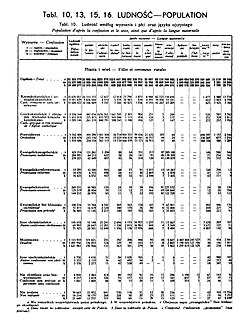
Key Facts
- Total Population: 31,915,779 people.
- Dominant Language: Polish was the most common mother tongue, spoken by 21,993,444 people.
- Primary Faith: Roman Catholicism was the largest religious group with 20,670,051 adherents.
- Methodological Shift: The 1931 census replaced the "nationality" question used in 1921 with a "mother tongue" question.
- Novel Categorization: The Ukrainian language was surveyed for the first time in the region, separate from Ruthenian.
- The "Local" Category: 707,088 people, primarily in Polesia, identified their language as "local" (tutejszy).
Demographic Breakdown by Language and Faith
The census categorized the population into several linguistic and religious groups. A notable aspect of the data is the distinction between Ruthenian (Rusyn) and Ukrainian speakers. While both were surveyed, they exhibited different religious leanings: Ruthenians were overwhelmingly Greek Catholic (96.5%), whereas Ukrainians were more evenly split between Greek Catholic (52.4%) and Orthodox (46.6%) faiths.
The Jewish population also presented a complex linguistic profile. While many spoke Yiddish, a significant number were fluent in Polish and Russian. Interestingly, the 1931 data showed an increase in the percentage of people identifying as Jewish by mother tongue compared to those who identified as ethnically Jewish in the 1921 census.
Below is a summary of the total population distribution by language and religion.
| Mother Tongue | Population | Faith/Religion | Population |
|---|---|---|---|
| Polish | 21,993,444 | Roman Catholic | 20,670,051 |
| Ukrainian | 3,221,975 | Orthodox | 3,762,484 |
| Yiddish | 2,489,034 | Greco Catholic | 3,336,164 |
| Ruthenian | 1,219,647 | Judaism | 3,113,933 |
| Belarusian | 989,852 | Protestant (All) | 831,258 |
| German | 740,992 | Other/Non-believer | 158,281 |
| Local | 707,088 | Not Declared | 39,663 |
Controversies and Interpretations
The "Local" Language Debate
One of the most contested parts of the census was the "Local" (tutejszy) category. This was particularly prevalent in the Polesie region. Critics, including a 1954 U.S. Census Bureau study, argued that this category was used to mask the true number of Belarusians. Conversely, the Polish government maintained that the categories were designed to be accurate to the respondents' self-identification.
Political and National Assimilation
Some historians suggest the shift from "nationality" to "mother tongue" was an attempt by the government to minimize the visibility of minorities. However, historian Timothy Snyder notes that after 1926, Poland pursued state assimilation—judging citizens by their loyalty to the state rather than their ethnicity—rather than national assimilation.
Post-War Revisions
Following World War II, Soviet-bloc interpretations often grouped all non-Polish speakers in South-Eastern Poland (including Ukrainians, Belarusians, Rusyns, Hutsuls, Lemkos, Boykos, and Poleszuks) into a single "Ruthenian" category to argue that these areas were majority non-Polish. There were also unverified claims that the former chairman of the statistical office, Edward Szturm de Sztrem, admitted to executive interference in the results, though no written confession has ever been produced.
Frequently Asked Questions
Why did the 1931 census use mother tongue instead of nationality?
The change was consistent with the prior census policies of Russia, Germany, and Austria in Polish lands. It shifted the focus from ethnic identity to the primary language spoken by the respondent.
What is the difference between Ukrainian and Ruthenian in the census?
The census surveyed them as separate categories. While some viewed Ukrainian as a newer name for Ruthenian used by nationalistic elements, the General Census Commissioner stated they were surveyed in parallel to accommodate "Old Ruthenians" who rejected the Ukrainian label.
How did the Jewish population identify in the 1931 census?
Most Jews spoke Yiddish, though many also spoke Polish and Russian. About 12% of Jews by religion considered Polish to be their mother tongue.
What was the "Local" (tutejszy) language category?
It was a category for people who did not identify with the listed primary languages. It was most common in the Polesie region and has been a point of contention for historians trying to determine the exact number of ethnic minorities.
Was the 1931 census considered reliable?
Reliability is debated. Some, like Tadeusz Piotrowski, called it unreliable for determining ethnicity, while others used adjusted figures to estimate that Belarusians outnumbered Poles in the Nowogródek and Polesie Voivodeships.