106th Congress Party Membership and Composition
The 106th United States Congress operated with a shifting landscape of party affiliations and membership changes. Understanding the distribution of power between the Democratic and Republican parties during this period provides insight into the legislative dynamics of the era, as vacancies and shifts in membership influenced the final voting shares in both the Senate and the House of Representatives.
Key Facts
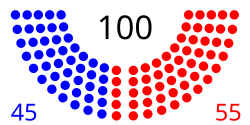
- The Senate began the session with 45 Democrats and 55 Republicans.
- The House of Representatives started with 211 Democrats, 1 Independent, and 223 Republicans.
- Senate membership was affected by two deaths during the term.
- The House of Representatives experienced three deaths and two resignations.
- The final voting share in the Senate was 46% for Democrats and 54% for Republicans.
- The final voting share in the House was 48.5% for Democrats, 51.2% for Republicans, and 0.3% for Independents.
Senate Membership Dynamics
The Senate entered the 106th Congress with a total of 100 seats, split between 45 Democrats and 55 Republicans. Throughout the term, the composition fluctuated due to vacancies caused by two deaths. For instance, on October 24, 1999, the Senate operated with 99 members and one vacancy, which was resolved by November 2, 1999.
Further shifts occurred in 2000. On July 18, 2000, a vacancy returned, leaving 99 members, before the Senate returned to full strength on July 25, 2000, with 46 Democrats and 54 Republicans. By the start of the subsequent Congress, the Democratic count rose to 50.
House of Representatives Composition
The House of Representatives began with 435 members: 211 Democrats, 223 Republicans, and 1 Independent. Unlike the Senate, the House faced more frequent membership changes, including two resignations and three deaths.
Membership numbers fluctuated throughout 1999 and 2000. On March 2, 1999, the House had 434 members with one vacancy. By December 8, 2000, the House ended the term with 433 members and three vacancies. The final voting distribution reflected a Republican majority, though the margin remained competitive.
Comparative Membership Summary
| Chamber | Starting Democratic | Starting Republican | Other/Vacant | Final Voting Share (D/R/O) |
|---|---|---|---|---|
| Senate | 45 | 55 | 0 | 46% / 54% / 0% |
| House | 211 | 223 | 1 Independent | 48.5% / 51.2% / 0.3% |
Frequently Asked Questions
How many deaths affected the Senate during the 106th Congress?
The Senate membership changed due to two deaths during this period.
What were the final voting shares in the House of Representatives?
The final voting shares were 48.5% for the Democratic Party, 51.2% for the Republican Party, and 0.3% for Independents.
How many vacancies existed in the House at the end of the term?
By December 8, 2000, there were 3 vacancies in the House of Representatives, leaving 433 active members.
Did the Senate start the 106th Congress with any vacancies?
No, the Senate began the session with a full complement of 100 members (45 Democrats and 55 Republicans).
What caused the membership changes in the House of Representatives?
Membership changes in the House were caused by three deaths and two resignations.